Fibonacci Retracement Guide for Traders
Fibonacci retracement is one of the most widely used tools in mechanical study. It helps traders predict where the market might pull back before continuing in its original direction. Because of its flexibility, Fibonacci works across forex, stocks, crypto, supplies, indices, and even algorithmic models.
The Fibonacci Retracement Guide teaches traders how to correctly apply Fibonacci levels, interpret pullbacks, and combine them with convergence to improve entries and risk organization.
What Fibonacci Levels Mean in Trading
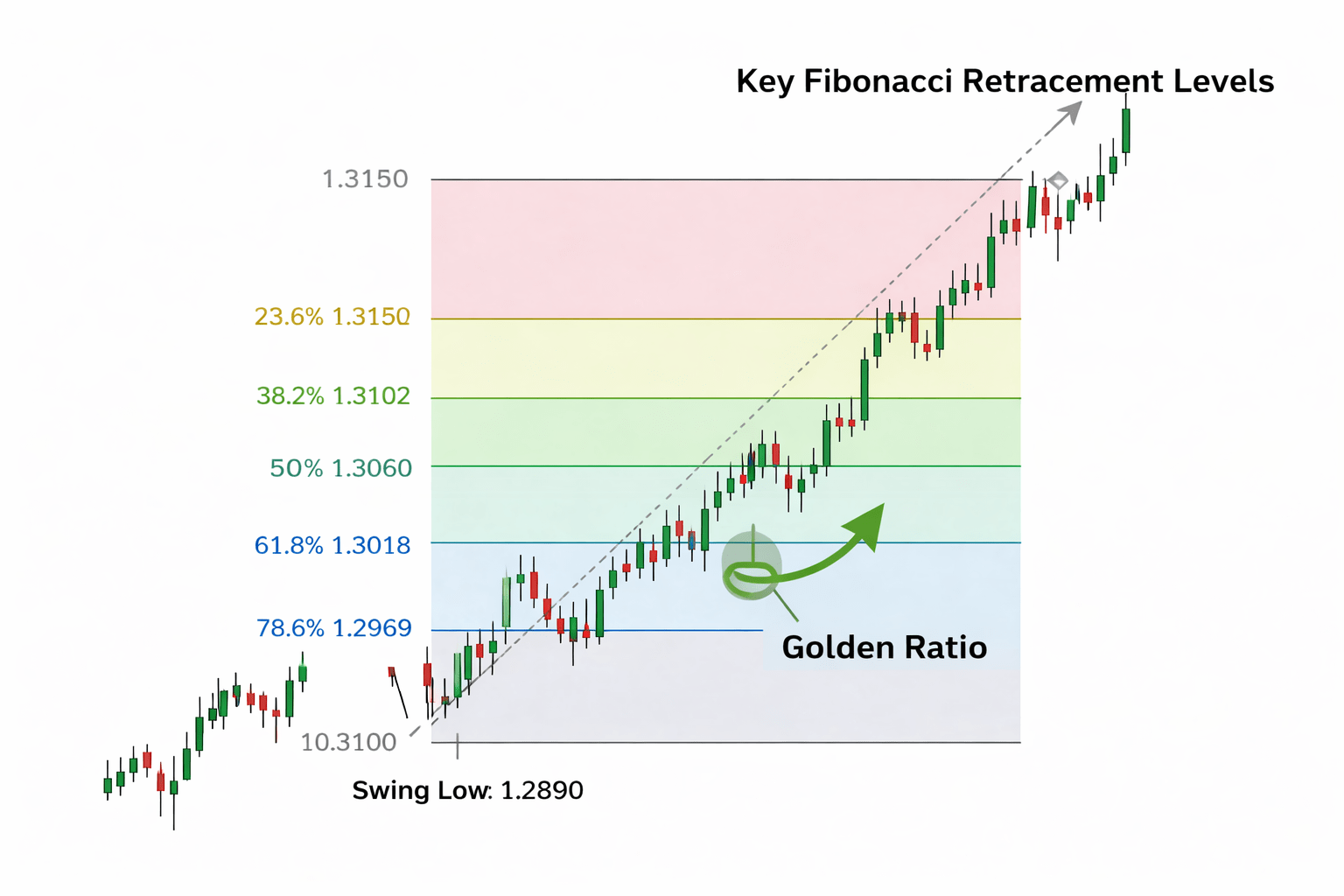
The Fibonacci tool uses ratios derived from the Fibonacci sequence. The most commonly used retracement levels are:
✔ 23.6%
✔ 38.2%
✔ 50%
✔ 61.8%
✔ 78.6%
Among these, 61.8% — also called the Golden Ratio — attracts the most interest from professionals.
How to Use Fibonacci in Different Market Conditions
The rule is simple:
➡ In uptrends: draw Fib from swing low to swing high
➡ In downtrends: draw Fib from swing high to swing low
This allows the trader to wait for the pullback instead of chasing price, which increases entry precision and reduces emotional trading.
Confluence is Where Fibonacci Becomes Powerful
Traders rarely use Fibonacci alone. The real accuracy happens when it overlaps with:
- Support & Resistance
- Supply & Demand Zones
- Order Blocks (ICT concepts)
- Market Structure (BOS / CHoCH)
- EMA / MA trend filters
- Candlestick confirmations
- RSI / MACD divergence
When 2–3 confluences align at the same Fib level, win probability increases significantly.
Example Setup Explained
A common bullish Fibonacci setup looks like this:
- Uptrend forms higher highs and higher lows
- Trader draws Fibonacci from low → high
- Price retraces into the 61.8% zone
- Bullish confirmation candle forms
- Entry occurs at retracement
- Target placed at prior high or extension levels
Extensions like -27% and -61.8% are common profit targets used by institutional traders.
Risk Management & Stop Loss Logic
The book emphasizes stop placement based on Fibonacci structure:
✔ Stop loss below retracement level in uptrend
✔ Stop loss above retracement level in downtrend
This approach avoids random stop hunts and fits how liquidity is engineered around Fibonacci levels.
Who This Guide Helps
This book is suitable for:
✔ Forex traders
✔ Crypto traders
✔ Stock traders
✔ Scalpers & Swing traders
✔ ICT-style smart money traders
✔ Beginners learning technicals
Why Fibonacci Still Works in 2024+
The reason Fibonacci remains relevant is simple: markets are influenced by human behavior, liquidity, and mathematics. Even smart money concepts, Wyckoff structure, and algorithmic models repeat patterns that align with Fibonacci rati
FAQS
It helps traders identify potential pullback levels where price may reverse or continue within a trend.
Yes. It works in forex, stocks, crypto, commodities, futures, and indices because it’s based on market structure, not asset type.
Many traders focus on the 61.8% level due to its role as the Golden Ratio, but 50% and 38.2% are also heavily respected.
Yes. It’s considered beginner-friendly and is often one of the first tools traders learn in technical analysis.
It works best with confluence such as support/resistance, demand zones, moving averages, or price action signals.