ICT Forex Trading Strategy for Smart Money Traders
The ICT Forex Trading Strategy has become one of the most influential and widely studied modern trading approaches. ICT (Inner Circle Trader), developed by Michael J. Huddleston, focuses on understanding how institutional money moves the market through liquidity, market structure, displacement, mitigation, and order flow.
Unlike traditional indicator-based systems, ICT teaches traders how to recognize the hidden narrative behind price. The ICT model also overlaps with elements from Wyckoff, Smart Money Concepts (SMC), and Market Maker Theory, making it one of the most complete institutional frameworks.
Smart Money vs Retail Logic
Retail traders rely on indicators such as RSI, MACD, moving averages, or breakouts. Smart money, on the other hand, focuses on:
✔ where stops are positioned
✔ where liquidity pools sit
✔ where the market needs to rebalance
✔ how price manipulates retail entries
ICT traders often call this “where the food is” — referring to liquidity that institutions hunt before reversing price.
Market Structure & Liquidity
ICT trading begins with understanding structure:
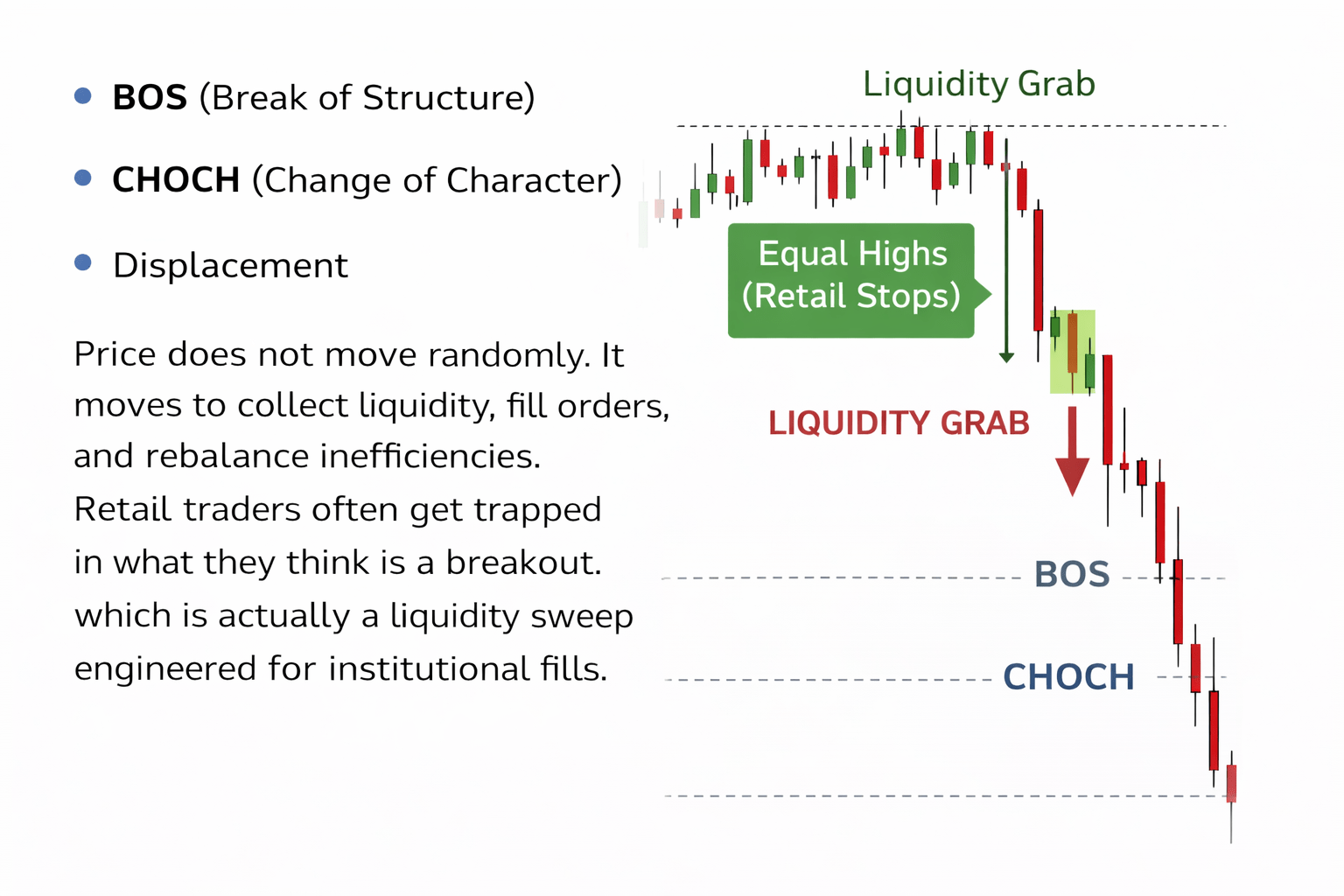
- BOS (Break of Structure)
- CHOCH (Change of Character)
- Displacement
- Liquidity grabs
Price does not move randomly. It moves to collect liquidity, fill orders, and rebalance inefficiencies. Retail traders often get trapped in what they think is a breakout, which is actually a liquidity sweep engineered for institutional fills.
SMT Divergence (Smart Money Tool)
SMT divergence is one of ICT’s most unique tools. Unlike standard divergences (RSI, MACD), SMT compares two correlated assets, for example:
✔ EURUSD vs DXY
✔ GBPUSD vs EURUSD
✔ NAS100 vs US100 Futures
The logic:
➡ If one pair makes a higher high while the correlated pair does not, liquidity is being engineered.
➡ This divergence often signals a reversal or mitigation opportunity.
This allows ICT traders to enter before retail confirmation appears.
Order Blocks & Mitigation
ICT reintroduced Order Blocks into retail trading terminology. These represent the last down candle before an up move (bullish OB) or the last up candle before a down move (bearish OB), which contain institutional orders.
After imbalance or displacement, price returns to these areas to mitigate unfilled orders. Traders use this for sniper entries with tight stop losses.
Example:
- Price sweeps liquidity above equal highs
- Impulse displacement moves market down
- Price retraces into bearish order block
- Entry taken at mitigation
- Stop sits above sweep level
Image section: bearish order block example
Wyckoff Accumulation and Distribution
ICT trading heavily overlaps with Wyckoff phases:
- Accumulation (smart money buys)
- Markup (trend up)
- Distribution (smart money sells)
- Markdown (trend down)
In accumulation, retail sells the bottom while institutions buy. In distribution, retail buys the top while institutions sell. ICT strategy helps traders identify these shifts before major moves.
Time & Session Theory
One reason ICT works exceptionally well in Forex is because of session timing. Liquidity events are clustered around specific windows:
✔ London Open (LO)
✔ New York Open (NYO)
✔ New York Killzone
✔ Asian Range
Retail traders rarely consider time. Institutional algorithms do.
For example:
Liquidty grabs often occur during LO, reversals during NYO, and continuations during NYSE.
Risk Management Logic
ICT emphasizes asymmetric risk:
Risk small, target large.
Typical RR ratios seen in ICT setups range from:
✔ 1:3
✔ 1:5
✔ 1:10
✔ 1:20 or more
Because entries are tight (order block or FVG) and invalidation is clear.
Who This Strategy Is For
The ICT strategy benefits:
✔ Forex traders
✔ Smart money traders
✔ Price action traders
✔ Algo + liquidity model traders
✔ Scalpers & day traders
✔ Futures & index traders
Especially those moving away from indicators toward structural reading.
Conclusion
The ICT Forex Trading Strategy provides a complete trading framework rooted in institutional logic rather than retail guessing. It teaches traders how to read liquidity, structure, time, divergence, mitigation, and risk management as a unified system.
For traders seeking to evolve beyond lagging indicators, ICT represents one of the most advanced systems available today.
FAQs
ICT teaches how institutional traders use liquidity, market structure, and timing to move price.
Beginners can learn it, but it requires patience because ICT concepts are more advanced than basic indicator trading.
No. ICT trading is primarily price-based and focuses on structure, liquidity, and session timing.
Forex, indices, futures, crypto, and stocks — anywhere liquidity mechanics exist.
It explains why price moves, not just what price is doing, which gives traders deeper context and cleaner entries.